

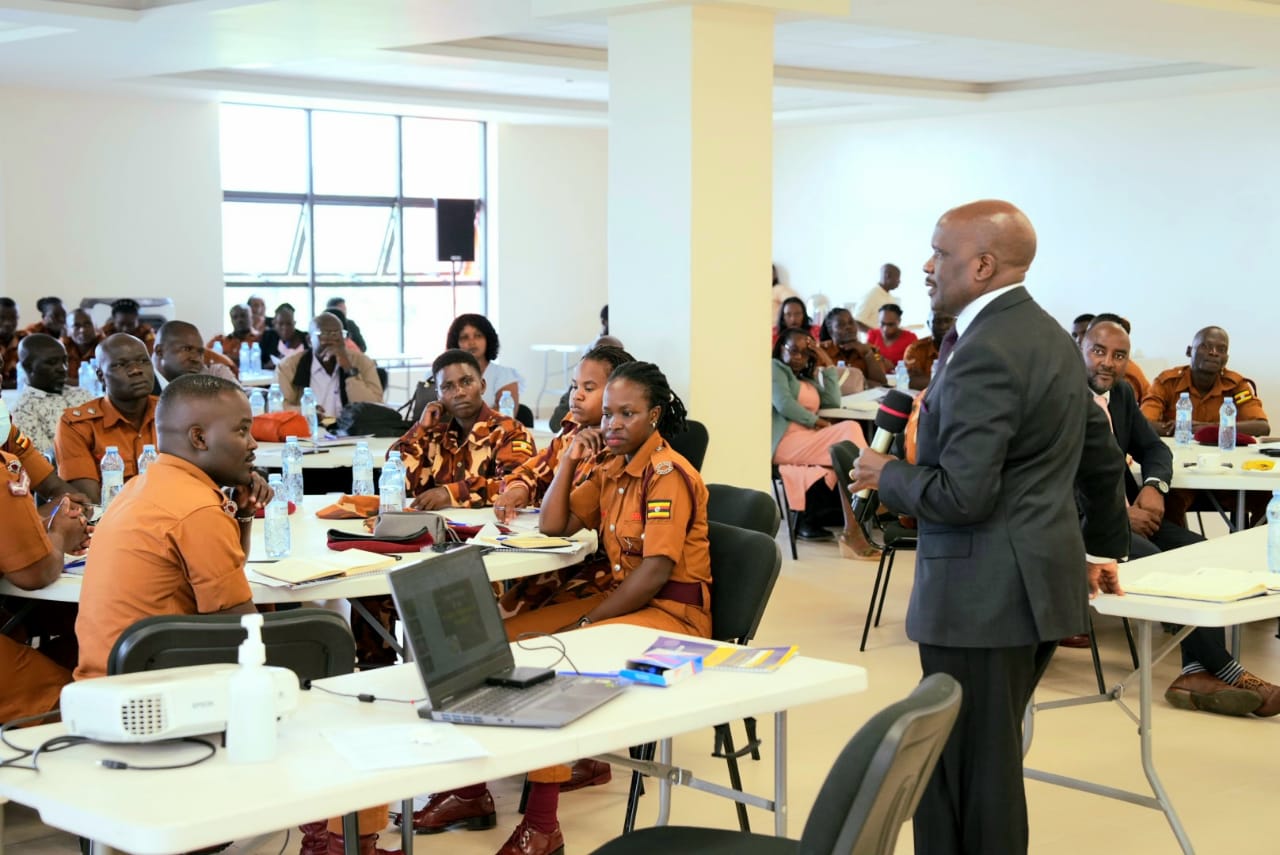
Government officers drawn from various agencies, particularly those in Uganda’s prisons sector, have been urged to rethink their reliance on monthly salaries and instead embrace entrepreneurship, disciplined saving, and investment as a pathway to long-term financial security beyond formal employment.
The call was made during a Dual Career Training Programme organised by Enterprise Uganda, which brought together public servants seeking practical guidance on retirement preparedness, wealth creation, and income diversification in the face of growing economic uncertainty and changing labour conditions.
The training targeted government employees concerned about life after service, with participants expressing interest in learning how to save consistently, invest wisely, and build alternative income streams capable of sustaining them beyond their public sector careers.
Key thematic areas included financial literacy, retirement planning, business sustainability, investment opportunities, and balancing entrepreneurship with formal employment.
Opening the session, Enterprise Uganda Director General Charles Ocici delivered a strong warning against overdependence on salaries, arguing that it leaves workers vulnerable once employment ends.
“The life of a salary earner is going to end in doom if that salary is the only source of livelihood,” Ocici said, adding that many employees fall into a comfort zone that limits innovation and long-term planning.
He noted that while employment provides stability, it often creates what he called an illusion of security tied to rank, title, and allowances rather than independent value creation.
“The money you earn as an employee is often determined by your rank, title and position rather than your ability to generate value independently. The danger is that one day that rank disappears, the title disappears, and the salary stops,” he warned.
Ocici stressed that employment inevitably comes to an end through retirement, restructuring, contract expiry, or unforeseen circumstances, urging participants to prepare early for that transition.
“A time comes when the contract closes. It may be because of age, retirement, restructuring or any other reason. The question is what happens next?” he asked.
He cited cases of former public officials who struggled financially after leaving office, arguing that status and titles do not guarantee long-term stability.
“The exit point is coming. It comes for everyone. The wise person prepares for it long before it arrives,” he said.
Dual career
A key focus of the programme was the concept of a dual career, where individuals maintain performance in formal employment while simultaneously building businesses and investments outside working hours. Ocici encouraged participants to start small and grow gradually rather than waiting for ideal conditions.
“Be an outstanding employee during the day, but build your enterprise outside working hours. You must learn to shine at work and build wealth beyond work,” he said.
He shared the example of educationist John Chrysostom Muyingo, who began by teaching children in his sitting room while still employed, later expanding the initiative into a large educational institution network. The story was used to illustrate how modest beginnings can evolve into sustainable enterprises through consistency.
“The biggest mistake many people make is waiting for perfect conditions before they start. Successful entrepreneurs start with what they have and grow from there,” Ocici said.
Financial literacy also featured prominently in the training, with participants encouraged to adopt disciplined habits of saving, investing, and reinvesting rather than increasing consumption in line with rising income.
Ocici outlined what he described as a cycle of wealth creation, where income is saved, invested, and reinvested to generate long-term financial independence.
“You earn income, you save part of it, invest it, and then reinvest the returns. That cycle is what creates wealth,” he said.
Participants were introduced to various investment options including government bonds, unit trusts, private equity, real estate, and small business ventures, with emphasis placed on informed decision-making and avoiding common financial mistakes.
Officials from the Ministry of Trade, Industry and Cooperatives also encouraged participants to adopt a more innovative and entrepreneurial outlook. A commissioner from the ministry said Uganda’s economic transformation depends on citizens who can create opportunities beyond formal employment.
“How do we become innovative and enterprising? How do we successfully balance employment and entrepreneurship?” he asked.
The ministry stressed that government efforts extend beyond job creation to equipping citizens with practical skills for business development and self-reliance, noting that entrepreneurship contributes to job creation and broader economic growth.
Time management was also highlighted as a critical factor in balancing employment and enterprise development. Ocici challenged participants to rethink how they use time outside work, arguing that lack of time is often a matter of prioritisation.
“Do not tell yourself that you have no time. The issue is often not lack of time but how we choose to use it,” he said.
Chief Operating Officer Ronald Mukasa also urged participants to reflect on the uncertainty of career longevity, noting that technological and economic shifts are forcing workers to prepare for multiple transitions.
“What happens when it ends?” Mukasa asked. “For some people, that end comes earlier than expected.”
As the training concluded, facilitators emphasised that the programme aimed not only to improve financial outcomes but also to shift mindsets towards long-term planning, resilience, and self-reliance.
Ocici reiterated that personal thinking plays a decisive role in financial outcomes.
“The way you think is the way you become,” he said.
The Dual Career Training Programme is part of Enterprise Uganda’s broader efforts to promote entrepreneurship, financial literacy, and wealth creation across different sectors of the economy.
For many participants, the central message was that while salaries provide stability, lasting financial security depends on disciplined saving, strategic investment, and the willingness to build enterprises alongside formal employment.
